Snowball the Cockatoo: The Dancing Bird Who Changed What Science Knew About Animal Minds

What would you expect from a cockatoo when the music starts?
A curious head bob, perhaps. A few excited squawks. Maybe some enthusiastic feather fluffing.
Snowball had bigger plans.
This sulphur-crested cockatoo became famous for moving to music, lifting his feet, rocking his body, and even headbanging like he had front-row tickets to a rock concert. His dancing was funny, charming, and impossible to ignore. It was also scientifically important.
Snowball helped researchers show that moving in time with a beat may not be a uniquely human talent. His story is one of the most delightful examples of amazing animal facts, and one of the clearest reminders that animal minds can surprise us.
Meet Snowball, the internet’s dancing cockatoo
Snowball is a male sulphur-crested cockatoo, hatched around 1996. He eventually came to Bird Lovers Only Rescue in Indiana in 2007 after his previous family could no longer keep him. Today, he lives with Irena Schulz at Bird Lovers Only Rescue in South Carolina.
At the rescue, Snowball quickly showed that he was more than a striking white bird with a bright yellow crest. When music played, he became animated. He rocked, bobbed, tapped his feet, and appeared to follow the rhythm.
The song that first made him famous was the Backstreet Boys’ “Everybody (Backstreet’s Back).” In 2007, a video filmed in Irena’s kitchen and living room showed Snowball moving along with the song. He was not simply making random movements while music happened to play in the background. His head and feet seemed to land with the beat.
The video spread rapidly on YouTube, back when viral animal videos were still a relatively new kind of internet magic. Snowball became one of the early celebrity pets of the online video era.
And yes, he had the crest, the attitude, and the stage presence to match.
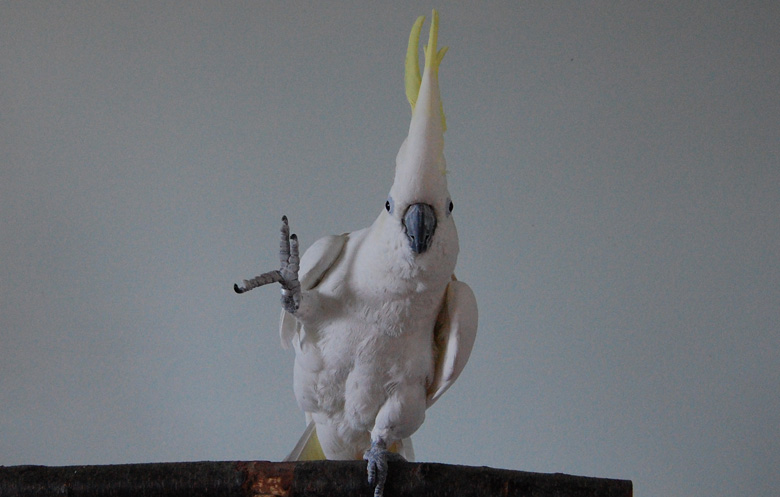
Scientists wondered: was Snowball really dancing?
To most viewers, Snowball’s performance looked like dancing. But scientists needed to ask a more careful question.
Was he actually hearing the beat and adjusting his movements? Or was he repeating a trained trick? Could the music have been added to a video after he moved? Was he copying a person nearby? Or was he simply performing natural cockatoo behaviours, such as head-bobbing and foot-lifting?
These questions mattered because beat synchronisation, also called entrainment, had long been considered a mostly human ability. People can hear a regular pulse in music and move along with it. We clap, nod, tap our feet, and dance faster or slower when the tempo changes.
For a long time, researchers had little strong evidence that other animals could do the same thing spontaneously.
Snowball changed that conversation.
Researchers, including Tufts University music-cognition specialist Aniruddh D. Patel, studied videos of Snowball moving to music. In earlier work, they tested whether he could adjust his movements when songs were slowed down or sped up. Snowball repeatedly changed his timing to match the altered tempo.
That was a major clue. He was not just making the same movement at the same speed every time. He appeared to be listening and adapting.
His 14-move dance repertoire
The 2019 study, published in Current Biology, took a much closer look at Snowball’s movements.
The paper, titled “Spontaneity and diversity of movement to music are not uniquely human,” analysed video of Snowball dancing to songs including Queen’s “Another One Bites the Dust” and Cyndi Lauper’s “Girls Just Want to Have Fun.”
Researchers examined the recordings frame by frame and identified 14 distinct dance movements, along with two composite movements that combined more than one action.
His repertoire included:
Headbanging
Body rolls
Foot lifting
Head-and-foot synchronisation
Side-to-side movements
Head swings
Semi-circle head sweeps
Poses
A “vogue”-style movement
The names sound like the set list for a very small, very feathery dance club.
The important point was not just the number of moves. It was the way Snowball used them. He switched between movements, varied his combinations, and responded differently to the same sections of music on different occasions.
That flexibility suggested he was not following a fixed routine.
Snowball was not trained to dance
One of the most fascinating parts of Snowball’s story is that he was not taught a choreographed dance routine.
He was not given a food reward every time he lifted a foot. Nobody trained him to perform a specific sequence of headbanging, body rolling, and dramatic posing. His movements appeared to develop through exposure to music, social interaction, and his own experimentation.
Researchers also noticed that Snowball performed some movements that Irena did not use when dancing with him. That does not prove that every move was entirely invented by Snowball, but it does suggest that he was not simply copying a human step for step.
The 2019 study found that he could create new combinations and vary his movements without being directed. In other words, Snowball was not just pressing the “play” button on a memorised trick. He seemed to be making choices.
That is where the science becomes especially interesting.
What makes a parrot capable of dancing?
The research team suggested that humans and parrots may share several important traits that help make rhythmic movement possible.
These include:
Vocal learning: the ability to learn and imitate sounds.
Complex mimicry: copying sounds, movements, or patterns.
The ability to imitate body movements.
The ability to learn movement sequences.
Attention to social cues and long-term social bonds.
Parrots are vocal learners, just as humans are. They are also highly social and often pay close attention to the people and animals around them.
The researchers proposed that these traits may work together. An animal that can listen closely, learn patterns, imitate actions, remember sequences, and care about social interaction may be more likely to move along with music.
But it is important to separate what the research demonstrated from what remains a hypothesis.
The studies showed that Snowball synchronised his movements with musical beats, adapted to changes in tempo, and produced a varied and spontaneous repertoire. Those are the observed findings.
The reason parrots and humans share these abilities is less certain. The connection to vocal learning is a strong scientific idea, but it is still an explanation being tested, not a final answer.

More than a funny video
It would be easy to see Snowball’s dancing as nothing more than a brilliant pet video. And, to be fair, it is also that. Watching a cockatoo throw in a body roll and a little headbanging is hard not to enjoy.
But Snowball gave scientists a rare opportunity to study animal musicality in detail.
His behaviour helped challenge the idea that dancing is purely a human cultural invention. It suggested that the ability to hear a beat and move with it may emerge when certain cognitive and social abilities come together.
The 2019 paper also pointed toward a wider field of research. Scientists noted that around 14 animals, including parrots and elephants, had appeared to keep a beat in different studies or observations. That does not mean every case is identical, or that all these animals dance in the same way. It does mean that rhythm and movement may be more widespread in the animal world than researchers once thought.
Snowball’s example encouraged scientists to look more closely at other species instead of assuming humans were the only animals capable of musical timing.
Snowball’s life as a rescue ambassador
Snowball’s fame has never been only about his dance moves.
As a rescue bird, he also became an ambassador for the challenges of caring for parrots. Large cockatoos are intelligent, social, noisy, long-lived, and demanding. They need attention, enrichment, space, and specialised care. They are not easy pets, and they should never be adopted simply because a video of a dancing bird looks adorable.
Snowball’s home at Bird Lovers Only Rescue gave him the chance to become a much-loved animal personality while also helping people understand parrots better.
He appeared in television segments, news stories, and features from outlets including NPR, The Washington Post, The Atlantic, and Tufts Now. His story reached people who might never have picked up a paper about music cognition.
That may be one of Snowball’s greatest gifts: he made a serious scientific question impossible to ignore.
The lasting legacy of a dancing bird
Snowball did not prove that cockatoos experience music in exactly the same way humans do. He did not tell researchers what a song means to him. We should be careful not to turn his movements into claims about feelings or thoughts that science cannot directly measure.
What he did show was remarkable enough.
Snowball responded to musical beats. He adjusted his movements when tempos changed. He used many different movements, varied them spontaneously, and appeared to invent combinations without training or food rewards.
That evidence changed how scientists think about rhythm, imitation, and animal minds.
It also gave the world one of the most memorable celebrity pets in recent history: a white cockatoo with a yellow crest, a strong sense of rhythm, and absolutely no fear of an enthusiastic headbang.
For animal lovers, Snowball is proof that the world is full of famous animals in history for many different reasons. Some are remembered for loyalty, courage, or service. Snowball is remembered for making science dance.
Learn more
Comments