Sinbad: The Stray Dog Who Officially Enlisted in the US Coast Guard

This is a modern illustration inspired by Sinbad’s story, not an archival photograph.
Some shipmates arrive with a seabag. Sinbad arrived as a stray puppy, and somehow stayed for the next 11 years.
In late 1937, the crew of the U.S. Coast Guard cutter George W. Campbell picked up a small mixed-breed dog in Atlantic City, New Jersey. Accounts differ on the details: he may have jumped aboard, or the crew may have brought him aboard after finding him as a stray. But the ending is the same. The puppy found a home at sea, and the crew soon made him an official member of the service.
Sinbad became one of the most memorable Coast Guardsmen of his era: a North Atlantic veteran, a media star, a troublemaker with a taste for sailorly refreshments, and a beloved companion to the people who served with him. His story has a special place among famous animals in history, and among the celebrity pets whose fame came from being more than just a cute face.
A puppy gets his own bunk, and his own service number
The crew welcomed Sinbad with more than a pat on the head. He had his own hammock or bunk, a place on the muster rolls, service paperwork and a service number: 069-069. This was not simply a nickname or a crew’s informal joke. Sinbad’s enlistment was recorded as official.
That paperwork suited the crew’s affection for him. Sinbad wasn’t a mascot who waved from the sidelines. He lived aboard the cutter, shared the ship’s routines and traveled wherever the Campbell went. He was a small dog among a big crew, but he had earned his spot.
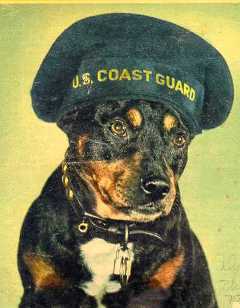
Sinbad’s portrait appears in his United States Navy Memorial service record.
A salty sailor with a soft spot for coffee
Sinbad’s personality helped make him famous. He was known for enjoying coffee aboard ship and, according to the stories told about him, beer and whiskey during shore leave. Those treats came with a less glamorous side of sailor life: Sinbad could make a mess, get into trouble and attract attention wherever he went.
His record included promotions and demotions, more than once. The crew might have loved him, but that didn’t mean he could get away with everything. One especially memorable incident took place in Greenland, where Sinbad's shore-leave adventures earned him a ban — the Coast Guard reportedly declared him unwelcome after an unauthorized spree ashore. Accounts of exactly what he did vary, which is half the fun.
It’s easy to see why sailors enjoyed telling Sinbad stories. He could be a scrappy shipmate one moment and a four-legged headache the next. That combination (loyal, unpredictable and entirely himself) made him feel less like a mascot and more like one of the crew.
Sinbad in the North Atlantic
During World War II, the Campbell took part in dangerous convoy duty in the North Atlantic. On 22 February 1943, the cutter fought German submarines and helped sink U-606. The engagement badly damaged the ship, including when the Campbell was rammed. Sinbad stayed aboard through the action and the difficult aftermath.
The cutter had suffered serious damage, and the crew faced the hard work of keeping her afloat and getting her to safety. Sinbad remained with the ship and his shipmates. In accounts of the battle, he is said to have slept through some of the action; either way, he was still aboard when the danger and damage were real.

An illustration evoking Sinbad’s convoy years. The real dog served aboard the Campbell through wartime action.
Sinbad earned wartime service ribbons and battle stars for his time at sea. His story also traveled beyond the ship. He appeared in newspapers, newsreels, radio and film, and was featured in LIFE magazine. During and after the war, he took part in fundraising and war-bond events, meeting people far from the rolling Atlantic.
For an animal already famous among Coast Guardsmen, all that publicity made him a national celebrity. But the heart of Sinbad’s story remained the same: he was a dog who stayed with his crew when they needed him.
Amazing animal facts: why ships had dogs and cats
Sinbad belonged to a long seafaring tradition. Ships have carried animals for centuries, including dogs, cats and other companions. Cats could help control rats and mice around food and supplies. Dogs could serve as companions, alert crew members to activity, and bring a little comfort and routine to life far from home.
Morale mattered, too. A ship’s crew could spend long stretches away from family, facing rough weather and demanding work. A familiar animal could make a vessel feel more like a community. Mixed-breed dogs like Sinbad (often celebrated as practical, adaptable “salts of the earth”) could fit naturally into shipboard life, though every dog’s temperament is its own.
And here’s another small fact for animal lovers: dogs can hear higher-pitched sounds than people, so a whistle or siren may catch a dog’s attention before it does yours. It’s a fun reminder that our animal companions experience the world a little differently. Sinbad’s particular talents, though, were less about fancy tricks and more about staying close to his shipmates.
Retirement at Barnegat Light
After roughly 11 years of service, Sinbad retired on 21 September 1948. His seagoing days were over, but he did not have to leave Coast Guard life behind. He spent his retirement at the Barnegat Light Coast Guard Station in New Jersey, where visitors came to see the famous old sailor.

An illustration imagining Sinbad’s peaceful retirement near Barnegat Light.
Sinbad died on 30 December 1951, at about 14 years old. He was laid to rest at Barnegat Light, where his memory is still connected to the station. His story is also preserved through Coast Guard historical accounts and his memorial record.
A Coast Guard legend with four paws
Sinbad’s legacy is not just a list of ranks, awards or adventures. It’s the story of a stray puppy welcomed by a crew, given a place aboard and kept close through years of service. He was mischievous, famous and steadfast, and clearly loved.
Today, Sinbad’s story lives on in Coast Guard histories and in the spirit of the service’s mascots: animals who bring companionship and a little extra heart to life around the water. For readers collecting amazing animal facts, Sinbad is a reminder that a shipmate doesn’t need two legs to earn a place in the crew.
Learn more
Comments