Grip: Charles Dickens's Raven Who Inspired Two of Literature's Most Famous Birds

There are celebrity pets, and then there are animals that stroll straight into literary history.
Grip was one of those animals. A common raven with a sharp mind, a wicked personality and a taste for mischief, she lived with Charles Dickens and his family in London during the late 1830s and early 1840s. Dickens adored ravens, but Grip became the most famous of the birds he kept.
She inspired a memorable character in Dickens’s novel Barnaby Rudge. Then, according to a widely accepted theory, she helped inspire Edgar Allan Poe’s “The Raven”: one of the most famous poems in the English language.
Not bad for a bird who reportedly enjoyed biting people.
Who was Grip?
Grip was a female common raven, hatched around 1839 in England. Dickens kept her as a household pet at 1 Devonshire Terrace in Marylebone, where she was treated rather like a cat or dog.
That did not necessarily make her a well-behaved member of the family.
Grip was known for being noisy, clever, curious and occasionally aggressive. She reportedly bit members of the Dickens household, including the children. Some accounts also say that she bit Dickens himself. She stole food, collected objects and buried treasures in the garden, including coins, cheese and other household items.
She was also a talented mimic. One of her best-known phrases was:
“Halloa, old girl!”
It is easy to imagine the scene: Charles Dickens at his desk, trying to write, while a glossy black bird wanders about the house, steals something valuable and shouts at somebody from the corner.
Dickens found her fascinating. In a letter to the artist George Cattermole, he described his idea for Barnaby Rudge: Barnaby, he wrote, would always be accompanied by a pet raven “immeasurably more knowing than himself.”
He added that he had been studying his own bird and thought he could make “a very queer character of him.”
“Queer” here meant strange, unusual and wonderfully odd. It was a perfect description of Grip.

Grip in Barnaby Rudge
Dickens’s novel Barnaby Rudge was published in 1841. It is set during the Gordon Riots of 1780 and follows Barnaby, a simple-minded young man who travels with his pet raven.
The fictional bird is also called Grip.
In the novel, Grip is more than a background animal. The raven adds humour, mystery and a slightly unsettling energy to the story. He seems to understand more than the people around him and often appears to be watching events with his own private plan.
The literary Grip says phrases such as “Nobody” and “Keep us, my dear.” His odd comments make him memorable because they are funny, but also a little eerie. A talking raven in a gothic historical novel is never going to feel entirely safe.
Dickens based many of the bird’s habits and mannerisms on his real pet. The fictional Grip moves, watches and behaves like a creature with a mind of his own: exactly the sort of bird Dickens had known at home.
A tragic ending involving lead paint
Grip’s life was short. She died on 12 March 1841, apparently after being poisoned by lead-based white paint.
According to Dickens’s account, Grip had developed a habit of tearing pieces from painted surfaces. She even drank paint from an open tin after workers had been decorating a stable. Nineteenth-century white paint often contained lead, and Dickens later suggested that Grip had consumed a dangerous amount.
When she became ill, a veterinarian was called. The bird was given castor oil, and Dickens briefly hoped she was recovering. Grip even returned to some of her old behaviour, biting the coachman.
But the improvement did not last.
Dickens later described Grip’s final moments in a darkly comic letter to his friend Daniel Maclise. He wrote that the bird walked around, stopped to bark, staggered, exclaimed “Halloa old girl” and died. Then Dickens added that the children seemed rather glad because Grip had bitten their ankles: “But that was play.”
It is a very Dickensian way to describe grief: sad, affectionate and just a little macabre.
Dickens had a post-mortem examination carried out because he briefly suspected that Grip might have been deliberately poisoned. In the end, the lead-paint explanation became the accepted one.
He was not ready to say goodbye. Dickens had Grip professionally taxidermied and mounted on a perch inside a wooden and glass case. He kept the preserved bird in his study, where she could continue watching him write.
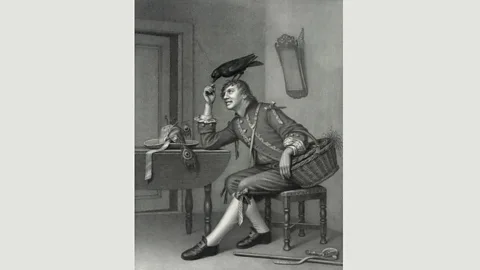
Did Grip inspire Edgar Allan Poe’s “The Raven”?
This is where Grip’s story becomes part of literary legend.
Edgar Allan Poe reviewed Barnaby Rudge and clearly noticed the raven. In one review, he called Grip “intensely amusing” and suggested that Dickens could have used the character even more effectively.
Poe and Dickens met in Philadelphia in 1842, during Dickens’s American tour. Poe was reportedly delighted to learn that the raven in Barnaby Rudge had been based on a real bird.
Three years later, in 1845, Poe published “The Raven.”
Scholars have widely argued that Dickens’s Grip helped inspire Poe’s poem. There are several reasons for the connection:
Both works feature a mysterious, intelligent and unsettling raven.
Both birds are closely associated with a troubled human character.
Barnaby Rudge includes a scene involving tapping and knocking, which resembles the famous tapping at the narrator’s chamber door in Poe’s poem.
Poe had reviewed the novel, met Dickens and expressed an interest in the raven.
Still, there is no surviving note in which Poe says, “I wrote the poem because of Grip.” So the connection is persuasive, but it is not proven beyond doubt.
One important detail is often missed: “Nevermore” is not a documented phrase spoken by the real Grip. The word belongs to Poe’s fictional raven. It is sometimes attached to Dickens’s bird because the two ravens became linked in popular memory, but the real Grip was recorded saying phrases such as “Halloa, old girl,” while the literary Grip said “Nobody” and “Keep us, my dear.”
The real bird was strange enough without borrowing Poe’s catchphrase.
What happened to Grip after Dickens?
After Dickens died in 1870, the mounted raven passed through several owners. It was sold at auction along with other Dickens possessions and eventually crossed the Atlantic.
The preserved bird later came into the collection of American collector Richard Gimbel. When Gimbel died, his collection was left to the Free Library of Philadelphia.
Today, Grip is displayed in the Rare Book Department of the Free Library’s Parkway Central Library. She is one of the library’s best-known artefacts and sits within a collection connected to both Dickens and Poe.
Grip was also designated a Literary Landmark in 1999. In a wonderfully gothic twist, she is not far from other Dickens-related objects, including material connected with the author’s pets and writing life.
Her journey from a London family home to a Philadelphia rare-book collection is remarkable. She began as a mischievous household raven and ended as a physical link between two major writers.
Dickens and his unusual family of pets
Grip was not Dickens’s only raven. After her death, he acquired another raven and gave it the same name. He later kept a third bird called Grip as well.
The later birds had their own reputations. One was described as mischievous and impudent. Another reportedly bullied the family’s large dog, Turk, and stole the best pieces of meat from the dog’s bowl.
Dickens also kept dogs and cats, and he was deeply attached to his animals. His interest in pets was unusual for the period, when animals were often viewed mainly as working creatures or property. Dickens treated them as individuals with personalities, habits and feelings.
He also supported animal welfare causes and wrote about animals with unusual warmth. Grip’s story shows that this affection could include a bird who was clever, destructive and thoroughly capable of making family life difficult.
Amazing animal facts about ravens
Grip’s intelligence may sound like something from a novel, but ravens really are among the cleverest birds on Earth.
Here are some amazing animal facts about ravens:
They can mimic human speech. Captive ravens raised around people can learn to copy words, phrases, animal sounds and even mechanical noises.
They use tools. Ravens have been observed using sticks, stones and other objects to help solve problems. They can also manipulate objects in surprisingly careful ways.
They can plan for the future. Studies suggest ravens can delay gratification, choose tools for later use and remember what they may need next.
They play. Ravens slide down snowy roofs, toss objects into the air and play with sticks and stones. Their games may help young birds practise skills.
They recognise individuals. Ravens can remember particular people and other ravens. Their complex social lives involve keeping track of who is friendly, threatening or important.
They can hold a grudge, at least in the everyday sense. A raven that has been mistreated may remember the person and react differently when that individual appears again.
They can live for decades. Wild ravens may live around 10 to 20 years, while captive birds have been recorded living for more than 40 years, with some records reaching even higher.
Perhaps that is why ravens have appeared so often in myths, legends and literature. They are beautiful, watchful and just intelligent enough to make us wonder what they are thinking.
Grip gave Charles Dickens a character. She gave readers a story. And, quite possibly, she gave Edgar Allan Poe the spark for a poem that would make the raven a permanent symbol of gothic literature.
For a bird who spent her short life stealing food, biting ankles and shouting “Halloa, old girl,” Grip left an extraordinary legacy among the famous animals in history, and remains one of the most fascinating celebrity pets of all time.
Learn more
Comments