Lonesome George: The Last Pinta Island Tortoise and the Face of Extinction

Lonesome George on Pinta Island in 1972. Photo: Ole Hamann / Galápagos Conservancy.
There are many famous animals in history, but few carried the weight of an entire species quite like Lonesome George.
For decades, this gentle giant tortoise was believed to be the last living member of the Pinta Island tortoise population, Chelonoidis abingdonii. He became known as “the rarest creature in the world,” a global conservation icon, and one of the most recognizable animals ever connected with the Galápagos Islands.
George died on 24 June 2012, at around 100 years old. His death marked the loss of the Pinta Island tortoise, but his story did not end there. Today, his preserved body has returned to the Galápagos, where it helps visitors understand both the tragedy of extinction and the hope created by conservation.
A tortoise found alone
Pinta Island, also known as Abingdon Island, once supported its own population of giant tortoises. But centuries of hunting by sailors and whalers had already reduced their numbers dramatically.
Then came the goats.
In the 1950s, goats were introduced to Pinta Island as a source of fresh meat. With few natural controls, their population grew quickly. By around 1970, tens of thousands of goats were competing with the island’s tortoises for food. They stripped away shrubs, grasses and other vegetation, leaving the island in poor condition.
In 1971, Hungarian-born scientist József Vágvölgyi was studying land snails on Pinta when he spotted something extraordinary: a single giant tortoise.
That tortoise was George.
The discovery was remarkable because the Pinta tortoise had been considered extinct. George was found alone, with no other known members of his kind anywhere on the island, or anywhere else. In 1972, Galápagos National Park rangers relocated him to the Tortoise Center on Santa Cruz Island, connected with the Charles Darwin Research Station.
The hope was simple: perhaps a female Pinta tortoise would eventually be found. Searches were carried out in the Galápagos and around the world, including investigations into tortoises held in zoos. But no suitable mate appeared.
George was on his own.
Life at the Charles Darwin Research Station
At the Charles Darwin Research Station, George lived in a protected enclosure and received daily care from Fausto Llerena, a Galápagos National Park ranger who became his longtime keeper.
Llerena cared for George for roughly 40 years. He fed him, monitored his health and spent countless ordinary days with an animal who had become extraordinarily important to the world.
The relationship was not a typical human-and-animal friendship. George was not a household pet, and he was never treated like one. Still, Llerena’s steady care gave George a safe home after the destruction of Pinta Island’s habitat.
The breeding center eventually became a destination for visitors. Over the years, hundreds of thousands of people came to see George. They were drawn by his size, his story and the strange sadness of meeting the last known individual of an entire island lineage.
He became a kind of conservation celebrity. One of the most famous “celebrity pets” in the broadest sense, even though he belonged to no person. George belonged to the Galápagos.
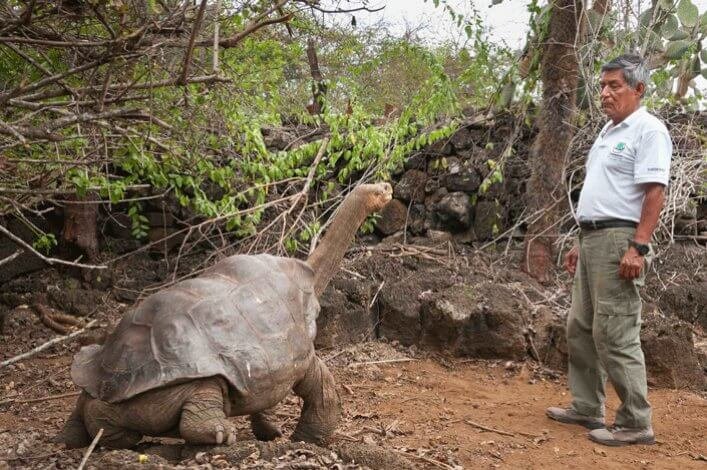
Fausto Llerena and Lonesome George at the breeding center. Photo: Tui de Roy / Charles Darwin Foundation.
Amazing animal facts about giant tortoises
George’s story is especially powerful because giant tortoises are not simply large reptiles. They are some of the most important animals in the Galápagos ecosystem.
Here are a few amazing animal facts about them:
Giant tortoises can live for more than 100 years. Some individuals have reached ages estimated at 170 years or more.
They can grow to around 1.5 metres long and weigh hundreds of kilograms.
They spend much of the day resting, conserving energy through a slow metabolism.
They can survive for extremely long periods without food or water by storing body fat and water.
They help spread seeds through their droppings, sometimes carrying seeds long distances across an island.
Their grazing, trampling and movement through the landscape help shape plant communities.
The tortoises also look different depending on the island where they evolved.
Some have domed shells, with rounded carapaces and shorter necks. These tortoises are generally associated with wetter highland environments, where food grows closer to the ground.
Others, including George, have saddleback shells. The front of the shell curves upward, giving the tortoise more room to stretch its long neck. This shape is useful on drier islands, where tortoises may need to reach higher leaves, shrubs or cactus.
These differences are a wonderful example of evolution responding to local conditions. Across the Galápagos, tortoises developed body shapes suited to the food, climate and terrain of their individual islands.
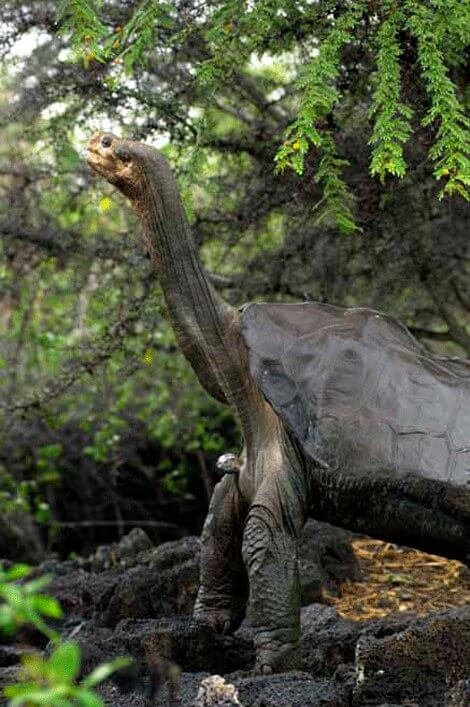
George’s saddleback shell helped him reach taller vegetation. Photo: Charles Darwin Foundation Library Archives.
The effort to continue George’s family line
Scientists and conservationists made repeated efforts to preserve George’s genetic legacy.
In the 1990s, two female tortoises from Wolf Volcano on Isabela Island were placed with him. They belonged to the population known as Chelonoidis becki, which was initially thought to be genetically similar to the Pinta tortoise.
George did mate with the females, and eggs were laid. In 2008, 13 eggs were collected and incubated. Sadly, they did not develop. Later clutches also failed. The eggs were infertile or otherwise non-viable, and no hatchlings were produced.
Further genetic research showed that Española tortoises were actually more closely related to Pinta tortoises than the Wolf Volcano population. Female Española tortoises were also introduced to George, but those attempts did not produce offspring either.
The result was heartbreaking: George left no direct descendants.
However, the research was not wasted. Genetic studies later found tortoises around Wolf Volcano carrying Pinta ancestry. These hybrid tortoises may have descended from Pinta animals moved to Isabela by sailors centuries ago.
Conservationists now study and manage these animals as part of a longer-term effort to recover some of the lost Pinta genetic heritage. Selective breeding may eventually produce tortoises that are genetically and physically similar to the original Pinta population.
George could not save his own lineage, but science may still help restore part of what was lost.
George’s final day
On the morning of 24 June 2012, Fausto Llerena found George dead in his enclosure.
George was estimated to be around 100 years old, although his exact age was unknown. Initial reports suggested heart failure or cardiac arrest as the likely immediate cause. A necropsy later concluded that he had died from natural causes associated with advanced age, with age-related changes noted in his liver.
His death was more than the loss of one animal. It meant that the Pinta Island tortoise was considered extinct.
That is why George became known as an “endling”. The last known individual of a species or population. An endling can make extinction feel personal. Instead of an abstract number or a line in a scientific report, extinction has a face, a shell and a life story.
A homecoming to the Galápagos
After George died, his body was frozen and shipped to the American Museum of Natural History in New York. Expert taxidermists carefully preserved him, completing the work in 2014.
He was later returned to the Galápagos in February 2017.
Today, Lonesome George is displayed at the Fausto Llerena Breeding Center on Santa Cruz Island, the facility named in honour of his longtime keeper. His exhibit forms part of the Galápagos National Park’s educational work and reminds visitors what is at stake when habitats are damaged and species are pushed toward extinction.
George’s body is no longer in New York. He is back in the islands that made him famous.

Giant tortoises continue to play an important role in Galápagos ecosystems. Photo: Anna Disegna / Galápagos Conservation Trust.
What Lonesome George left behind
George’s story has a bittersweet ending. No offspring hatched, and the original Pinta tortoise population could not be saved in time.
But his life helped change how people think about conservation.
The Galápagos National Park’s giant tortoise breeding programmes continue to protect vulnerable populations, raise young tortoises and restore them to islands where they once lived. Conservationists are also removing invasive animals, protecting nesting areas and studying tortoise movements across the islands.
The goal is not only to save individual tortoises. It is to restore the relationships that make an ecosystem work.
When giant tortoises return, they graze, carry seeds, create paths and influence the growth of plants. In their slow, steady way, they help rebuild the living landscape.
Lonesome George could not return to Pinta Island. But his memory continues to support the work of returning giant tortoises, and hope, to the Galápagos.
Learn more
Comments