Gander: The Newfoundland Dog Who Saved a Platoon in World War II

Some dogs become famous for starring in films, appearing on social media, or living in the homes of celebrities. Others become celebrity pets because their stories are simply too remarkable to forget.
Gander was one of those dogs.
A huge Newfoundland with a gentle nature, Gander became the mascot of the 1st Battalion, Royal Rifles of Canada. During the Battle of Hong Kong in December 1941, he repeatedly moved toward danger to protect Canadian soldiers. In his final act of courage, he picked up a live Japanese grenade and carried it away from wounded men.
Gander died in the explosion, but his bravery saved seven soldiers.
His story is one of the most moving examples of famous animals in history, and one of the most amazing animal facts you may ever hear about a family pet.
From family pet to army mascot
Before he was Sergeant Gander, he was known as Pal.
Pal was raised by the Hayden family at the airport base in Gander, Newfoundland. He was a friendly, playful dog who loved being around children. Like many Newfoundland dogs, he was also enormous. Newfoundlands are known for their size, strength, swimming ability, and calm personalities.
Pal enjoyed pulling children on sleds and playing with the local families. But his size sometimes made his games a little too enthusiastic. During one incident, he accidentally scratched a child’s face while playing. The family worried that someone might decide the big dog was too dangerous to keep.
Instead of allowing Pal to be put down, the family gave him to the Royal Rifles of Canada, a Canadian Army regiment stationed near the airport.
The soldiers welcomed him. They renamed him Gander, after the community where he had lived, and adopted him as their regimental mascot.

At first, Gander’s role was mostly about companionship and morale. In wartime, a dog could remind soldiers of home, family, and the ordinary life they had left behind. But Gander was not treated as just a mascot. The men saw him as part of the unit.
He was eventually given the honorary rank of sergeant.
That meant Gander was heading to war.
Gander goes to Hong Kong
In 1941, the Royal Rifles of Canada were sent to Hong Kong as part of “C Force,” a group of Canadian troops sent to help defend the British colony from Japanese invasion.
The journey was long, difficult, and dangerous. Gander travelled with the soldiers, arriving in Hong Kong in November 1941. The men took care of him in the hot climate, giving him food, water, and cool showers. His heavy Newfoundland coat was not ideal for tropical weather, but Gander stayed with the regiment.
The Battle of Hong Kong began on 8 December 1941, shortly after the attack on Pearl Harbor. Canadian, British, and other Commonwealth troops fought Japanese forces for more than two weeks.
Gander was in the middle of the fighting.
According to the PDSA’s official account of Gander, he directly engaged the enemy on at least three occasions. His dark coat and large size made him especially frightening when he appeared suddenly at night.
Gander would rush toward Japanese troops, barking and snapping at their legs. On two occasions, his attacks helped stop enemy advances and protected groups of wounded Canadian soldiers.
For the men around him, the sight of their enormous black dog charging into the darkness must have been unforgettable.
The grenade that changed his story forever
Gander’s final act took place on 19 December 1941 near Lye Mun Gap on Hong Kong Island.
A live Japanese grenade landed close to a group of wounded Canadian soldiers. The men were already injured and unable to move quickly. The grenade was about to explode among them.
Gander reacted immediately.
He ran to the grenade, picked it up in his mouth, and carried it away from the wounded soldiers. He was moving toward the enemy when the grenade exploded.
Gander was killed instantly.
The seven wounded soldiers survived.
The Hong Kong Veterans Commemorative Association’s record lists Gander’s date of death as 19 December 1941 and records the cause as “killed by grenade saving companions.”
It is difficult to imagine a clearer example of selfless courage. Gander did not understand medals or military orders. He was a dog doing what he had always done: staying close to the people he loved and reacting when they were in danger.
The Dickin Medal: an animal’s Victoria Cross
Gander’s actions were recognized many years after his death.
On 27 October 2000, he was posthumously awarded the PDSA Dickin Medal. The medal is often described as the animal equivalent of the Victoria Cross. It honours animals that show exceptional bravery while serving alongside military or civil defence forces.
Gander’s award was especially significant. He was the first Canadian animal to receive the Dickin Medal and the first recipient in many years.
The award citation recognized his three documented actions during the defence of Hong Kong. It also noted that, without his final intervention, many more soldiers could have been killed.

Gander is also part of a wider group of remarkable animals honoured with the Dickin Medal. Two other animals featured in this famous-pets series earned the same award, showing that courage is not limited to humans. Dogs, pigeons, horses, and other animals have all played important roles in moments of crisis.
You can learn more about the medal through the PDSA Animal Awards Programme.
Why is Gander famous?
Gander is famous because his story combines the things people love most about animals: loyalty, bravery, trust, and unconditional companionship.
He began life as a family pet. He was not trained as a traditional war dog, and he was not sent into battle with a special military mission. He was adopted by soldiers who cared about him, and he stayed beside them when they needed him most.
His actions also made a difference beyond one dramatic moment. Gander reportedly disrupted enemy advances more than once, guarded wounded soldiers, and helped protect the people around him throughout the Battle of Hong Kong.
That is why his story continues to appear in Canadian remembrance materials and lessons about animals in war. It is also why Gander stands out among famous animals in history. He was both an ordinary dog and an extraordinary hero.
Gander’s enduring legacy
Gander has not been forgotten in Canada.
His name appears on the Hong Kong Veterans Memorial Wall in Ottawa, alongside the names of the Canadian soldiers who served in the battle. Veterans insisted that Gander be included with the men he had served.
His Dickin Medal is displayed at the Canadian War Museum in Ottawa.
In his hometown, the Town of Gander’s Heritage Memorial Park includes a life-sized monument of Sergeant Gander and his wartime handler. The statue gives visitors a place to remember both the dog and the soldiers who fought with him.
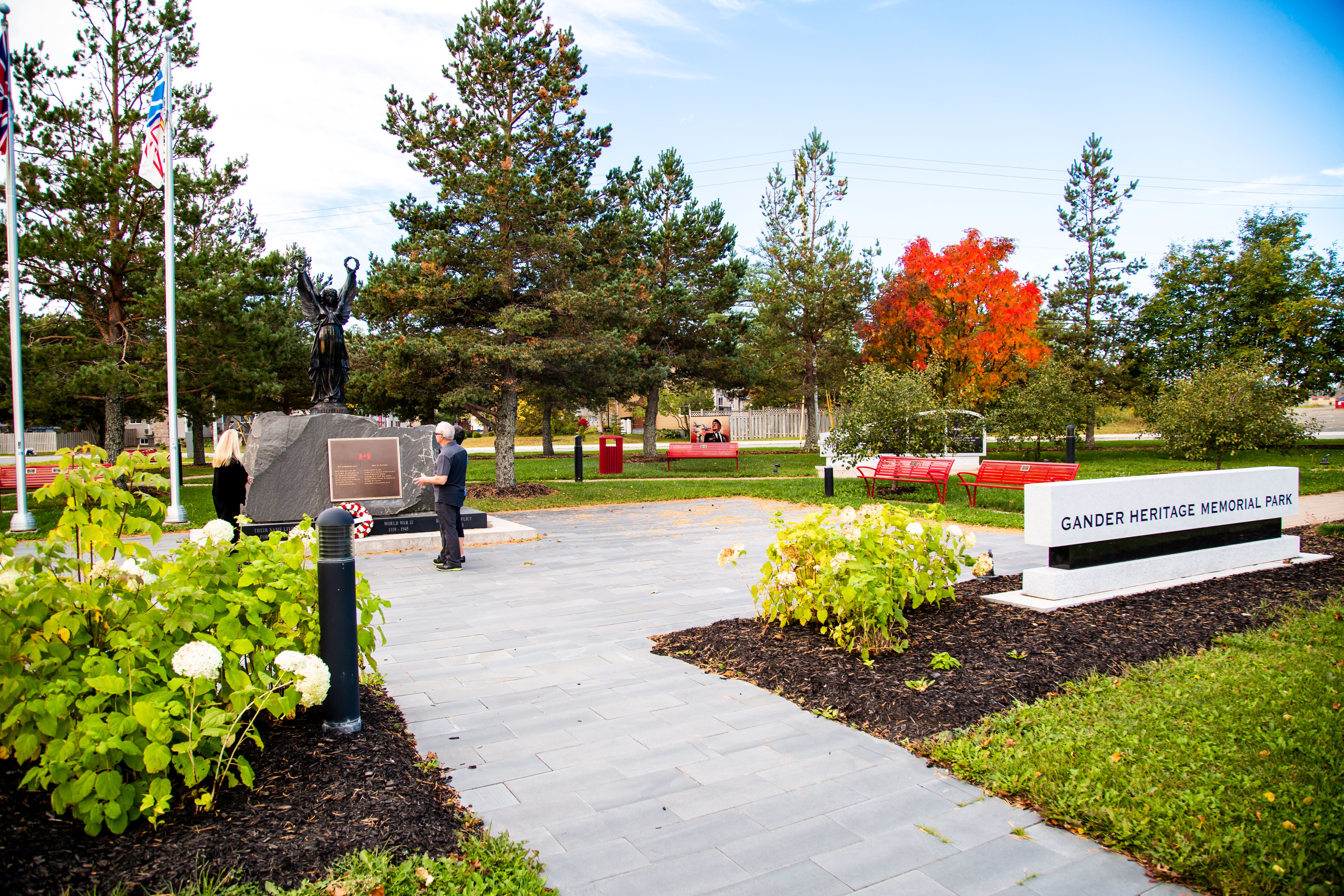
Gander’s story has also been preserved in books, including Sergeant Gander: A Canadian Hero by Robyn Walker and the illustrated booklet A Dog Named GANDER, produced by the Hong Kong Veterans Commemorative Association.
There does not appear to be a verified school officially named after Gander. However, his story is used in Canadian school lessons and remembrance activities, including resources from Veterans Affairs Canada. A memorial created as a gift to the children of Gander also helps connect his memory with younger generations.
That may be the most fitting legacy of all. Gander’s story is not kept only in museums or military records. It is shared with children, families, readers, and animal lovers who continue to discover what he did.
Remembering a very good dog
Gander was a family pet, a mascot, a soldier, and a friend.
He gave comfort to Canadian troops far from home. He faced danger during one of the darkest periods of the Second World War. And when a grenade threatened wounded soldiers, he acted without hesitation.
Nearly 85 years later, his story still feels immediate. It reminds us that animals can be brave in ways we do not expect, and that the bond between people and their pets can reach far beyond everyday life.
Gander was not famous because he sought attention. He became famous because, when his people needed him, he ran toward danger.
That is why Sergeant Gander remains one of Canada’s most unforgettable animal heroes.
Know another animal lover who would remember Gander? Share this story with them on social media.
Comments