Frida: The Mexican Navy Labrador Who Became a Hero of the 2017 Earthquake Rescue

In Mexico, few dogs have become as beloved as Frida. With her yellow coat, protective goggles, little boots, and steady manner, the Mexican Navy Labrador became a familiar face in some of the world’s most difficult disasters.
Frida worked in earthquakes, landslides, and collapsed buildings. She searched where people could not safely go. Her nose helped rescue teams find survivors and locate victims. Most of all, her calm presence gave people something to hold on to during moments of fear.
That is why Frida belongs among the most remarkable famous animals in history, and among the most inspiring celebrity pets, even though her “celebrity” life began in a working-dog unit rather than a home.
Who was Frida?
Frida was born on April 12, 2009, and entered the Mexican Navy’s canine unit as a puppy. The Secretaría de Marina, commonly known as SEMAR, trained her to search for people trapped in collapsed structures.
Her handler, Israel Arauz Salinas, described her as calm, reliable, and especially suited to rescue work. Their success came from teamwork: Frida searched, listened, and followed scent, while her handler read her signals and directed the wider rescue operation.
It is worth clearing up one part of Frida’s origin story. She is often called a “rescue dog,” but that means a dog trained for search and rescue. Public biographies do not establish that she was adopted from a shelter or rescued from homelessness. They do show that she was acquired by SEMAR and trained from puppyhood for this important work.
Frida completed her training unusually quickly and developed a specialty in collapsed-structure searches. Her job was not simply to run through rubble. She had to work safely around unstable concrete, sharp metal, dust, heat, noise, and unfamiliar smells.
Goggles, boots, and a harness built for danger
Frida’s protective equipment became part of her identity.
Her goggles protected her eyes from dust and flying debris. Her small boots helped shield her paws from broken glass, hot surfaces, sharp rubble, and rough concrete. She also wore a harness that allowed rescuers to lower her into places that were too dangerous or narrow for a person.
The equipment was practical, but it also made Frida instantly recognizable. Photographs of her moving across disaster zones in full gear spread around the world.

Image via ABC News.
A career across several countries
Frida’s career lasted about a decade. She worked in Mexico and joined international deployments after major disasters, including:
The 2010 Haiti earthquake
The 2011 tsunami and disaster response in Japan
The 2016 Ecuador earthquake
The 2017 earthquakes in Mexico
Landslides and other emergencies in Guatemala, Peru, and Mexico
She also worked after explosions and structural collapses. In each mission, her role was part of a larger operation involving handlers, military personnel, engineers, medical workers, and local rescue teams.
Frida is often described as having “saved 53 lives.” The number is part of the popular story surrounding her, but the official figures need a little care. Navy-based accounts and major news reports most consistently credit her with helping locate 12 people alive and finding the remains of more than 40 others. The number 53 is generally connected with the number of rescue operations, not 53 survivors.
That distinction does not make her story less powerful. Finding even one person alive in a collapsed building can mean everything to a family. Frida’s official record also reflects the work of her handlers and the teams around her. She was not working alone, and her achievements belong to a remarkable human-and-dog partnership.
The 2017 Mexico City earthquake
Frida became a national symbol after the September 19, 2017, earthquake in central Mexico.
She was about eight years old by then: an experienced working dog, but also an older athlete facing exhausting conditions. Wearing her boots to protect her paws from the rubble and heat, she searched through collapsed structures in Mexico City.
One of the most painful sites was a school that had collapsed while classes were in session. Frida and her handler were assigned to help survey the area. Images of her moving carefully over the wreckage appeared on television, in newspapers, and across social media.
The pictures were unforgettable: a small Labrador in goggles, walking toward danger while exhausted people watched and waited.
Frida did not personally find a large number of survivors in that particular earthquake, despite some later retellings. But her presence mattered. She represented the thousands of people searching, digging, carrying supplies, comforting strangers, and refusing to give up.
Her image became the face of the rescue effort. People gathered to applaud when she passed by on military vehicles. Artists created drawings and fan art. Murals appeared in Mexico City, including in the Colonia Roma area. Her story was shared worldwide with messages of hope and hashtags such as #HastaSiempreFrida.
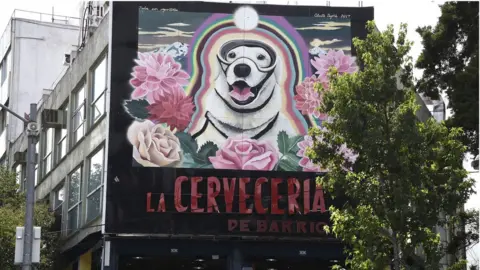
Frida’s image became part of Mexico City’s public art and memory. Image via BBC News.
Amazing animal facts: how rescue dogs find people
Frida’s work also shows why search-and-rescue dogs are so valuable.
Here are a few amazing animal facts about these canine specialists:
The Federal Emergency Management Agency explains that canine search teams can locate live human scent deep in rubble. These teams may also be trained to detect human remains after live searches are complete.
Retirement and the last goodbye
In June 2019, Frida retired from active rescue work at around ten years old. At her retirement ceremony, her handlers removed her famous goggles and boots. Instead of more field equipment, she received a toy for her new life.
It was a touching change. For years, those boots had meant another difficult mission. Now they marked the end of her frontline service.
Frida continued helping the next generation of SEMAR rescue dogs learn their work. Her experience became part of the training passed on to younger dogs and their handlers.
In 2022, SEMAR announced that Frida had died of natural causes at age 13. Mexico mourned her again. A farewell ceremony and official tributes honored her service, while her image appeared beside messages thanking her for bringing hope to the country.
A statue of Frida and her handler was unveiled in Puebla, with a plaque describing them as symbols of the strength Mexicans can show when they unite for a greater cause. Another monument was later placed near the Navy’s facilities in Mexico City.

Frida and Israel Arauz Salinas worked as a search-and-rescue team. Image via ABC News.
Frida’s lasting legacy
Frida’s story is not only about numbers. It is about trust.
She trusted her handler. Her handler trusted her nose. Rescue teams trusted her signals. And people watching from behind barriers trusted that her work meant there was still a chance.
The popular version of Frida’s story sometimes turns her into a lone superhero. The real story is even better. She was an extraordinary dog supported by skilled handlers and dedicated rescue teams. Together, they helped people in Haiti, Ecuador, Mexico, and other disaster zones.
Frida showed the world what a working dog can do. She also changed how many people in Mexico viewed dogs, as intelligent partners, brave helpers, and members of the national community.
Her goggles and boots are now symbols recognized far beyond the places where she worked. Her murals and statues keep her memory alive. And every new SEMAR rescue dog trained to search through rubble carries a small part of Frida’s legacy forward.
Frida may have retired from the rubble, but she never stopped being a source of hope.
For more stories about remarkable animals, explore the work of NPR’s remembrance of Frida, BBC’s report on her retirement, and the ABC News profile of Frida and her handler.
Comments