Fala: The Scottish Terrier Who Lived in the White House and Became America's Most Famous Dog

Some dogs are beloved by their families. Others become famous in their own right. Fala was both.
A small black Scottish Terrier, Fala lived in the White House, travelled with a president during the Second World War, appeared in newsreels, received thousands of letters and even became part of one of the most memorable political speeches in American history.
His story is one of the most heartwarming, and surprising, tales among the famous animals in history.
From “Big Boy” to Fala
Fala was born on 7 April 1940. His first name was “Big Boy,” and he was originally bought by Franklin D. Roosevelt’s cousin, Margaret “Daisy” Suckley. Daisy had intended to keep the puppy herself, but she eventually gave him to President Roosevelt.
The puppy arrived at the White House on 10 November 1940, when he was about seven months old. Roosevelt gave him the grand formal name Murray the Outlaw of Falahill, inspired by a Scottish ancestor. Thankfully, the name was shortened almost immediately.
“Fala” was easier to say, easier to remember and, before long, known across the country.
Daisy Suckley helped train the little terrier and remained an important part of his life. She took many photographs of him, recording his early days with the president and helping preserve the private side of Fala’s story.
The president’s constant companion
FDR and Fala became inseparable.
Fala followed the president around the White House and spent time with him at his office. At night, he slept in a special chair at the foot of Roosevelt’s bed. Each morning, a bone was reportedly brought up on the president’s breakfast tray for him.
Fala also travelled wherever Roosevelt went. He joined him on trains, ships and planes, and appeared at wartime meetings and official engagements. He was present during important trips, including the 1941 Atlantic Conference with Winston Churchill.

The Secret Service reportedly gave Fala the nickname “The Informer.” If people spotted Fala, they knew the president was probably close by.
Behind the scenes, Fala also had a reputation for causing a little trouble. White House staff members joked that he became a convenient scapegoat whenever something went wrong. If FDR was annoyed that something had not been done, staff could jokingly blame Fala, or claim they had been busy feeding him.
The joke became so familiar that staff reportedly said they sometimes fed Fala simply to keep the president from nagging them.
Fala even broke the White House rule against pets sleeping in the bed. The story is usually told as a funny example of his special status: Fala climbed into the president’s bed, and Roosevelt gave him what some staff members considered the closest thing to a scolding the famously patient president ever gave anyone.
Whether every detail of that story can be proven is difficult to say, so it is best treated as White House folklore. But there is no doubt that Fala received unusual access and affection.
A dog with his own public career
During the war years, Fala became much more than a president’s pet. He became a national celebrity.
Newspapers and magazines regularly published stories about him. Photographers looked for him at the White House, on presidential journeys and at public events. He appeared in newsreels and was featured in films made by MGM, including Fala, the President’s Dog.
He also became connected with wartime morale campaigns. Fala was named honorary president of Barkers for Britain, a group of dog owners raising money to support Britain during the war. He was also presented as an honorary Army private.
Fala received so much fan mail that a secretary was assigned to answer it. That is one of those amazing animal facts that sounds too unusual to be true, yet it reflects just how famous he had become. His letters were preserved, and many are now part of the collections connected with the Roosevelt Library.
He even had official-looking dog tags and personal memorabilia, including toys, a food bowl and a stuffed sock. These ordinary objects help show that behind the public legend was still a playful little dog who enjoyed the same simple things as any other pet.
The “Fala Speech” of 1944
Fala’s most famous moment came during the 1944 presidential campaign.
In July of that year, Fala travelled with Roosevelt during a Pacific journey that included a visit to the Aleutian Islands. A false story later circulated claiming that Fala had been accidentally left behind on one of the islands. According to the rumor, Roosevelt had then ordered a Navy destroyer to return and rescue him, supposedly costing taxpayers millions of dollars.
The story was not true. But Roosevelt’s political opponents repeated it, and the president decided to answer it with humour.
On 23 September 1944, at a Teamsters Union dinner in Washington, D.C., Roosevelt delivered what became known as the “Fala Speech.”
He said:
“Well, of course, I don’t resent attacks, and my family doesn’t resent attacks, but Fala does resent them.”
Roosevelt continued by imagining Fala’s reaction to the accusation:
“His Scotch soul was furious.”
The speech turned a political attack into a personal and funny story. Instead of sounding defensive, Roosevelt made the rumour seem ridiculous. He also reminded listeners that the president was not only a wartime leader and political figure, but a dog owner who loved his pet.
Fala’s name became permanently linked with the 1944 campaign. It was a remarkable example of a celebrity pet becoming part of national political history.
Fala at the centre of wartime life
Fala’s public appearances helped humanize Roosevelt during some of the most difficult years in American history.
The president was leading the United States through the Great Depression and the Second World War. His health was fragile, and the responsibilities of office were enormous. Photographs of him with Fala offered the public a glimpse of a quieter, more personal side.

Fala was not a mascot in the modern commercial sense. He was a real companion who happened to be constantly photographed. His presence at meetings and on journeys was not simply a publicity trick. The surviving photographs and memories suggest that Roosevelt genuinely wanted him nearby.
That closeness also explains why the “Fala Speech” worked so well. Americans already knew the dog. They had seen his face in newspapers and newsreels. They had read stories about his travels and received letters from him, answered by his secretary. When Roosevelt said Fala was offended, millions of people understood the joke.
After Roosevelt’s death
Franklin D. Roosevelt died on 12 April 1945. Fala was still with him during the final years of his presidency.
After FDR’s death, Fala went to live with Eleanor Roosevelt at Val-Kill, the Roosevelt family retreat in Hyde Park, New York. Eleanor cared for him for the rest of his life. Fala also attended Roosevelt’s funeral, travelling in the train car behind the president’s casket at Eleanor’s request.

Fala remained part of the family, but age gradually caught up with him. He grew grey and became largely deaf. After suffering from stomach trouble, he died on 5 April 1952, just two days before his twelfth birthday.
He was buried in the Rose Garden at the Roosevelt family home in Hyde Park, close to Franklin and Eleanor Roosevelt. His grave remains a place visited by history lovers and dog lovers alike.
Fala’s lasting legacy
Fala’s fame has lasted because he represents something simple and deeply familiar: the comfort of a loyal pet during an extraordinary life.
Today, a bronze statue of Fala sits beside Franklin D. Roosevelt at the Franklin Delano Roosevelt Memorial in Washington, D.C. According to the National Park Service, it is the only presidential pet statue at a presidential memorial.
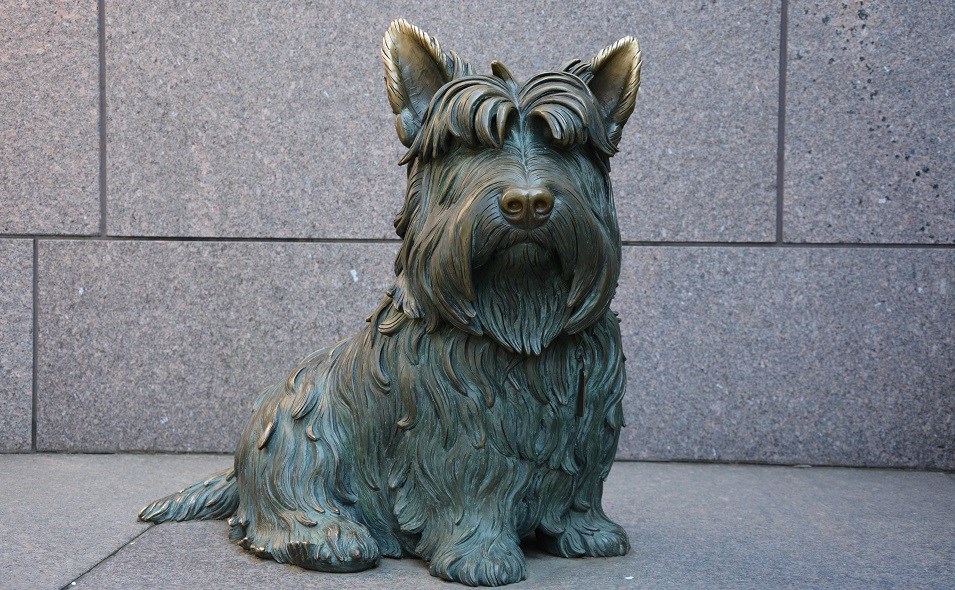
Visitors often touch the statue’s head, ears and nose, leaving those areas brighter than the rest of the bronze. It is a small sign that Fala still attracts affection from people who never knew him.
The FDR Presidential Library preserves his collar, photographs, letters and other memorabilia. His story also helped establish the idea of the “First Dog” as a recognizable part of American public life. Presidential pets had existed before Fala, but he was the first to become a true national celebrity.
That is why Fala remains one of the most famous celebrity pets, and one of the most memorable animals in American history. He was a travelling companion, a wartime morale figure, a political punchline and, above all, a much-loved dog.
For more archival photographs and artifacts, explore the Franklin D. Roosevelt Presidential Library’s collection about Fala, the National Park Service’s history of Fala, and the FDR Library’s digitized photographs.
Fala’s story reminds us that even in the middle of world-changing events, a dog can offer something wonderfully ordinary: companionship, comfort and a reason to smile.
And that may be the greatest legacy of America’s original First Dog.
Sources and further reading
Comments